


“I trust your heart. I just don’t trust you to do your job.”
I’ve heard that phrase said and have said it more often than I care to admit.
Everybody wants to be trusted, but there has to be some level of demonstrated competence to pull it off. You can’t just be asking princesses to leap onto your flying carpet with your perfectly white teeth.

I build my definition of trust in the following way:
Trust is our confidence in the safety and integrity of one’s relationships, leading to free-flowing cooperation.
But there’s a lot to what builds that confidence. I’ve spoken of trust as commitment and trust as consistency. These build off of Horsager’s Eight Pillars. But there’s another: trust as competence.
You Can Be Awesome and Still Be Incompetent
I don’t mean that as a slight. You don’t want me to be your phlebotomist and I don’t want you to be mine. We can trust people in numerous spaces but, for many of us, we have to trust them to do the role (or roles) they exist in our lives to do. You can’t get by on being nice and having white teeth alone.
In The Ideal Team Player Pat Lencioni talks about the person who has humility and high emotional intelligence but no hunger—no drive to improve, to get work done, or to excel at what they do. What does he call that person?
The lovable slacker.
I’ve seen it up close. The person you love to sit with and talk to. The person you’d call when you need to know you’re loved or need someone to take you to lunch. Good people. Loving people. But they also struggle to do the job that’s before them.
Imagine getting called after leaving a meeting. The leader wants to talk.
“Hey. I’d like to know what you want us to do about meeting your prep.”
“What do you mean?”
“You don’t seem ready, don’t come prepared. I think it sets us back.”
“Hmm. Not sure.”
Okay.
But it’s true: you can be the best person in the world and one I’d trust to watch my kids for a month, but you still have to be able to do the job of the team you’re on.
People can trust my intentions, but they must trust my competence, too.
I Thought the “D” stood for “Done”
Eight years ago I walked across a stage for what I hope was the last time. That’s why you get terminal degrees, and I was finishing up the most terminal of them all. Now I get to spend my days telling everyone what I’ve learned and why I’m important.
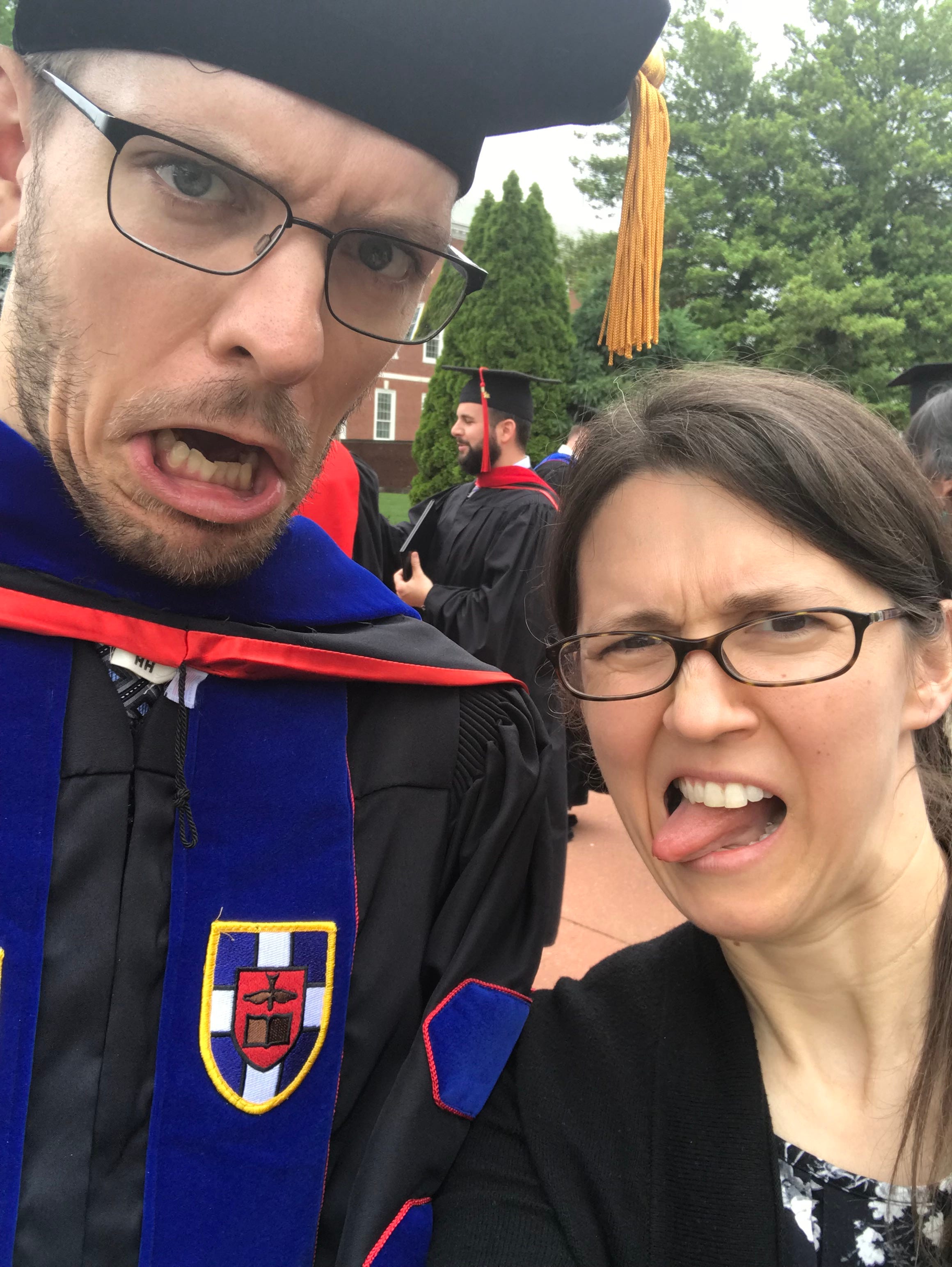
First off, nobody cares. Or, more precisely, the ones who do care aren’t the ones you usually want to grab coffee with because they want something from you.
Second off, really, nobody cares.
A year after getting the degree, I found myself pastoring a new church in a new town. My training, in many ways, meant nothing. Those folks didn’t care about a dissertation on megachurch pastoral succession, modified balanced scorecards, or the paper on dreams in Islam.
Could I do the job I’d been asked to do?
But that meant I needed to learn new ways. I reinvented my prayer life. I sort of learned how to work on a staff of two instead of however many were at my previous job (15? 20?). I had to make lots of meeting agendas.
Then I started teaching on the side.
I had the terminal degree, but I had never made a full syllabus. Lecture 2-3 hours a night for 12-15 weeks? Sheesh. How do you do that?
You ask someone who is better at it how they do it and you steal every bit of their skills.
Then our church decided to merge with another and instead of one of the orgs doing a classic donation and dissolution (standard fare on how to pull it off), we went the more expensive and circuitous path of starting a new entity and then completing two donations and dissolutions.
Another thing that fancy degree didn’t prepare me for. But my research had helped me cross paths with a guy who had done it before (a lot of times, actually), so I reached back out to him. Also, lawyers.

Resting on prior competency to address current issues won’t get you very far. Even if some people call you doctor.
What’s Next?
The truth is, in some spheres we feel competent and in others we don’t. But there’s room to grow.
Every time I feel this burden toward improvement, I have a moment of reckoning. “I don’t want to have to do that. I shouldn’t have to. It’ll require too much work. Will anybody notice if I don’t?"
For the first half of 2026, I’ve spent a couple of hours on Wednesday mornings in an online class with a group of people I’ve never met in person. Why? Because some of the folks I’ve been working with this year needed help that I knew I could be more equipped to give them.
It was time to knock the rust off.
I exhaled when I thought “Okay, 25 Wednesdays with homework and forced engagement. I can do this.” (I don’t love forced interaction.)
What I didn’t expect was just how helpful it’d be to me (irrespective of its help to others, honestly). People I’ve never met from all over the world take time every week to make me better. A happy accident waiting for me on the other side of realizing I had a lot of room to improve (yet again).
Who needs you to knock some of the rust off?
But really….I think I could be your phlebotomist! 🤪