


For the regulars, you’ve seen that I walked a lot in 2025. In fact, I walked over 400 miles on dedicated walks over the course of the year. This doesn’t include my non-activity steps throughout the day (which, when included, brings the watch-based mileage to over 2,000 miles for the year).
Most of those steps were alone with my own thoughts and prayers. I have found that the more output I have in life, the more time I need to process. On times I’m not alone with my gait, it’s because Courtney has joined me. We also took several walks with friends from church. Over the break I walked with two of our boys for a quick getaway from a family party.
During a walk after Christmas, and right after Courtney and the boys traveled to Louisiana for about ten days, I finished up a podcast I listen to semi-regularly. On it, the contributors were asked what their favorite piece of journalism was outside of their own platform.
One contributor went back to an article from the beginning of 2025, “The Anti-Social Century” by Derek Thompson of The Atlantic (paywalled, but can be found on Apple News if you have it).

This article doesn’t rant about loneliness—in fact, Thompson highlights the difference between loneliness (which many people do not feel) and solitude (which is used in the article as being “the only person in the room” even if on a device engaging with others). I started this article from a coffee shop by myself; I’m in solitude for all intents and purposes.
(The irony isn’t lost on me that I listened to this article while walking by myself.)
Thompson’s thesis:
The individual preference for solitude, scaled up across society and exercised repeatedly over time, is rewiring America’s civic and psychic identity. And the consequences are far-reaching—for our happiness, our communities, our politics, and even our understanding of reality.
I found much in the article to be true. Yet there was this unspoken part of me as I considered the people I’ve engaged with over years—men, in particular—who struggle to connect with peers. I think about that long-tenured meme (though the number can be debated, thanks to Judas):
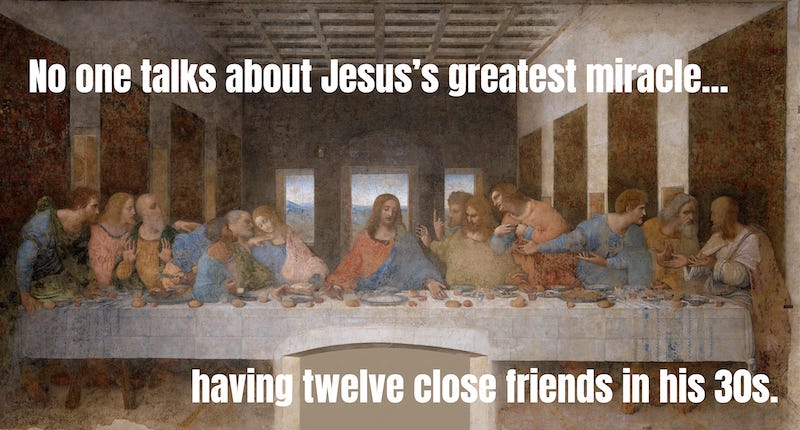
This article reminded me of something I wrote about years ago and say to anyone who will listen: if you want friends, you have to be a friend.
Easier said than done. In fact, we often view our relationships—even our closest ones—as transactional. I’ve done it, too.

However, realizing just how much solitude impacts our culture, I thought more about how this impacts us when it comes to our friendships—men, in particular.
Friendship: A Lost Art, Especially for Men
I come across people who suffer from relational isolation. They so badly want friends but they can’t seem to cross the divide. This feeling can result from one’s crushing insecurity, self-imposed “my spouse is my best friend” jargon,1 the simple fact that some of us are quite difficult to befriend, or something that falls in between.
One aspect I find, at least anecdotally, is this: we want something from people we often have not first been willing to give.
Our cultural phrases teach us that we should know better.
You get out what you put in.
No pain, no gain.
Be the change you want to see.
Whatever your phrase, I’ll say this: friendship is hard. To be a friend takes a significant amount of work.
Men, we cannot meaningfully connect to others as genuine friends without significant sacrifices. In other words, it’ll cost you.
Time: Friendships aren’t built in solitude and don’t get cooked in a microwave. You have to invest substantial time with people—very often without much in return. Not only that—and they don’t teach you this in school—but you might have to put in significant time with people before you find one you might have a strong connection with. And the place you might have to give up time in order to be with others? Your “me” time.
Money: I’m not talking about buying friends, which would be a Michael Scott strategy. I’m talking about being generous. Be the one who buys lunch with no paybacks. Even if you have people over, you’re providing them something from your fridge or pantry. It’s always money well-spent but it needs to be a part of how you think nonetheless. Our general rule as a family with our boys’ friends: If they’re with us, they don’t pay, because they’re part of the family at that moment.
Pain: To let someone get close enough to hurt you is a vulnerable thing, but it comes with the territory. In fact, the ones you let get the closest to you are the ones who will hurt you the most. When you’re face to face with someone who has hurt you (or you’ve hurt), you can’t walk away from your device. You’re stuck there, and you have to deal with it.
For some, these costs are a no-brainer. For others, they’re a bridge too far. However, if you want the benefits of deep friendships, you have to pony up.
Sow Seeds of Friendship Wide
I don’t plan to stop walking anytime soon. It’s where I process, pray, and consider those people in my life who are dear to me. The solitude helps prepare me for the face time with others. But I don’t live for the solitude.
We keep our Christmas cards up the entire next year. This display is largely due to our own lack of desire to take them down. People come over and are surprised by the number. I’d say we got roughly 90 in 2025 (which isn’t that many). Still, we’ve been at it a long time, so you get a card from someone and you go, “Shoot, I guess we need to send them one, too.” There’s some formality to it I laugh over.
But how many did we send? Over 400. People don’t see that part.
Doing the math, that means for about every four cards we send, we get one back.
But the math is irrelevant because we don’t send out cards to get cards. We send out cards to make one more connection with people in our lives. Some we know well, others not as well, but each family matters.
Those 90 will be staring at us throughout much of 2026 and give me a reminder. At times, we take a card down and tell the kids a story about the family and something we appreciate about them. We might pray for them, too.
All that to say: sow seeds of friendship wide and see what harvest may come.
What do I mean? Invest broadly in people who cross your path. Take them to coffee. Invite them over. Ask them questions about where they came from and what they’re passionate about. Shoot, go a little over budget to feed them. Let yourself be interrupted by them.
Then, do it again. This time with someone else.
You may not realize how many new relationships begin to form.
This phrase is one I do have a mini-concern with, though I understand the sentiment. I’ve heard “I’m married to my best friend” said almost as a way to say, “and I don’t need anyone else in my life.” But your spouse already has a hard job: being your spouse. To heap being your potential only close friend on top of that puts an inordinate amount of pressure on an already hard job, which includes seeing you naked
Author Commentary
Bonus Feature: A fun song
Always great to learn someone else is a Dispatcher!