


This post kicks off the refocusing of the Substack to “No Manual for This.” For the coming weeks, I’ll take areas of our life where we know we want to see more but aren’t sure exactly how to get it. Today’s post: how do we get people to talk when they’re conditioned to disengage?

I’ve been in too many hours of team meetings to count. Quick syncs, half-days, full days, multi-day retreats—it all comes with the territory of work, doesn’t it? I’ve noticed—as both a participant and facilitator—we often want one thing that’s hard to come by: we want more people to speak up. Give a challenge, give an encouragement, give something. Instead, people just stare off at their devices and wait for time to expire.

We hope that people will just magically begin chiming in. “This is important!” we think. “They should care about the conversation.” But what we might really be feeling is, “I care about this topic and think they should, too. Why do you guys hate me?”
I know you’ve been there. You don’t have to have a workplace to feel it. You could be leading a group at your church, or a book club, or a volunteer committee. We always want engagement, but it often feels underrepresented.
How do we bridge that gap between what we hope happens and what normally happens? How do we get people to speak up? We read a book or listen to a podcast that says we should mine for conflict, but that’s easier said than done. Conflict sucks. Teachers manage classrooms. How do we manage adults?
I’m going to go out on a limb here and assume that not everyone you work with is some sort of disengaged meeting ogre. (Stay with me, even if you think that’s a stretch.)
What I’ve found is that even the most well-versed meeting participants need reminders that speaking up is okay. What’s often lacking is permission.
I noticed this trend years back. I’d sit in meetings—meetings with people who have led successful careers. I’d assume, “Successful career? Must be great in a meeting room.” Couldn’t be less true. Quiet, tired, often disengaged—not ideal traits.
But that doesn’t mean people don’t have good things to say. The problem is, the people in the room are holding onto their ideas, unsure if they can share them—or unsure when to share them.
So I started to make a game of it.
It started with playing cards. Everyone would get an even number of reds and blacks (the number depended on meeting length). Playing cards don’t really have colors broadly associated with positivity (unless you’re an accountant or a gambler) so I had to define the colors.

Red was the challenge card. You had to play it if you challenged, questioned, or just plain disagreed with what was being said. Black was the encouragement card. You played it when you liked an idea and wanted to build on it.
The rule: You had to play all your cards before the meeting was over. They were essentially your minimum meeting engagement budget.
I would be at a pause in a meeting and survey the room. If someone hadn’t played any cards, they’d be forced to. They could pick literally anything to challenge or encourage (“I didn’t like the way you pronounced ‘ogre’”), but they’d have to say something before the meeting continued.
I use Leader Care branded poker chips now (red and green like traffic lights—thanks, Etsy), but the point is the same: challenge and encourage.
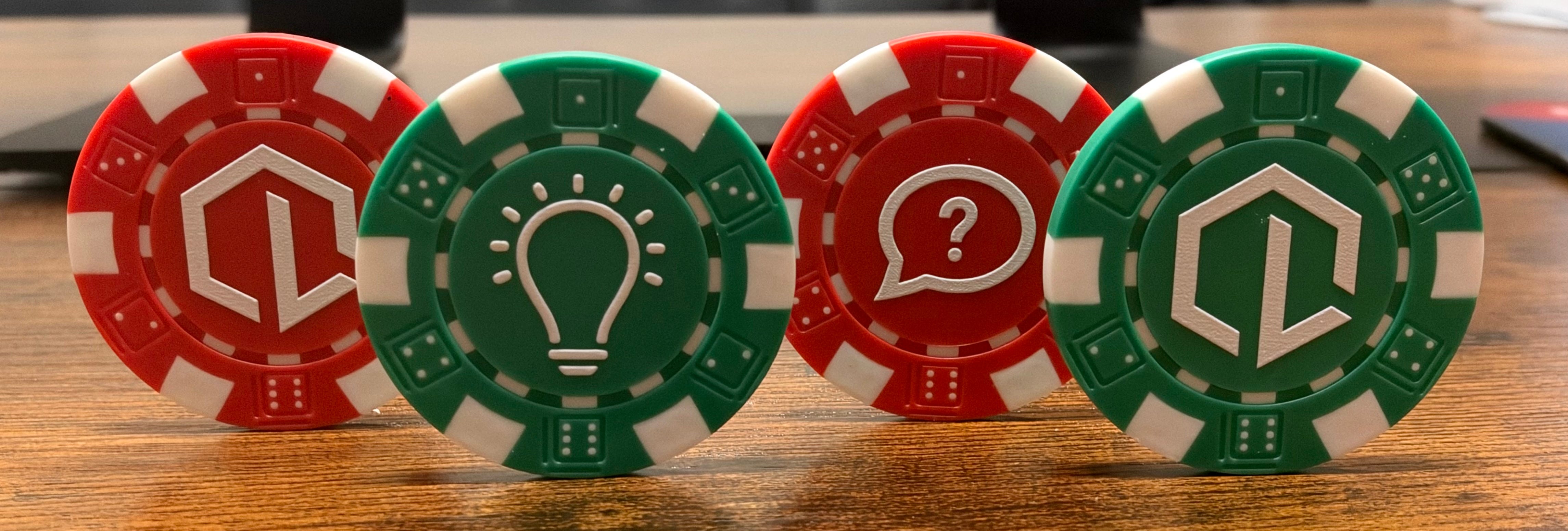
And—almost magically—people shared more. Those cards (or chips) would sit in front of folks reminding them they had something to say. Some people would hold them like fidgets. Some just placed them in front of their seat and waited. Some stressfully hoped I’d ignore them because they hate challenging. It was pulling them into the conversation. Hard to have a phone in your hand when you’re holding poker chips.
Another dynamic that began to change? People in the room would look around at how much “budget” teammates had. It’d slow them down and make room for someone else who might not be as talkative. People began to make room for each other.
It’d also set our expectations, because sometimes not knowing what someone was going to say would cause anxiety. When someone threw down a red chip, we knew a challenge was coming. We didn’t have to guess. A green chip meant we were going to keep running with an idea.
If your meetings don’t require focused engagement, why have them?
In all, we began looking for helpful ways to speak up rather than waiting for a conversation to finish and moving on to the next item. In-meeting conflict goes up, relational safety goes up, and the meetings after the meeting go down.
And we did it by making conflict and encouragement a game and expectation.
But what about you? What has worked for you? Let us know.
I want to know if Lyndsey feels this experience has helped her open up more in other types of group settings.