


Maybe you’re familiar with the RACI matrix—a delegation chart.
The responsible is the one doing the work.
The accountable is the one ultimately in charge of the project.
The consulted don’t do the work but are brought in when their voice matters.
The informed are those who need to know what’s going on at the right time.
One word: Boring.

One question: Are we allowed to say “RACI” anymore? It has an unfortunate homonym that I think might get you fired.

One thought: The chart doesn’t even flow in a logical order. Why would the second person on the list be the one ultimately responsible?
Then again, running around saying “ARCI” isn’t really any better, is it?
ORCA Delegation Clears up the Confusion
One staff meeting, I simultaneously lamented our staff’s struggle to appropriately assign responsibility and my disdain of RACI because it won’t work. Within five minutes, maybe my most favorite staff creation came about—from word to dumb GPT-created logo.
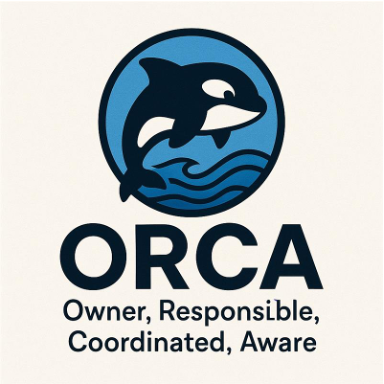
O – Owner: The person ultimately accountable for the item being discussed. Any item in question only has one owner. We cannot make a department or team the owner. However, an owner might exist on a team of responsible parties.
R – Responsible: The doer(s). They’re hands-on, executing the work and moving the ball forward. They report to the owner. An event or ministry might have multiple areas of responsibility, but there is still one responsible person per task or deliverable.
C – Coordinated: The people who need to stay in sync on any project. They often interact with the responsible party or parties. They’re not doing the work, but their input, timing, and/or alignment matters.
A – Aware: These are the people who are kept in the loop. They’re informed, not involved in the doing or deciding, but benefit from visibility. Awareness helps them stay aligned and ready to support if needed.
Implementing ORCA
Say you have an idea or there’s a new project. The flow becomes simple.
Assign the Owner: Any project or task the team is working on needs one leader—the Owner. You should keep asking, “Who owns that?” until it’s crystal clear and one name is attached.
Determine Spans of Responsibility: The Owner helps determine the other roles needed. Owners can also have some area of responsibility, should their time allow, but the responsible parties all need to know what they’re responsible for.
Let your Rs Run Free: Not too free, but their lane should be clear enough that they know what to do. They can bring in the people they need (Cs, largely) to get it done.
Make Aware When Needed: The group who needs to be aware can change, but the people closest to the activity likely have the best idea of who needs to be where.
By using ORCA, you bring some clarity to your collaboration (and yes, whales). It helps us avoid confusion, reduce duplication, and ensure everyone knows their role and who they’re responsible to—so we can serve with excellence and move forward together.
Author’s Commentary: The value of ORCA for the team.
When we landed on this language, we recorded a podcast on it for our church. You can listen below (the discussion happens on the back third of the podcast)