


The below is another section from the memoir Courtney and I are working on, You Talk Too Much.
There was a point in time—well, half of 2019—where tunnel vision took over. Our house was full of issues and I had a list of solutions. The solution I thought most important was to tear up my house, get down to the foundation, apply epoxy, and then rebuild.
When I told an epoxy floor guy my problems he said, “I’d just sell it.”

I was committed, though. We were going to fix the problem. Well, I was going to fix it. Courtney was just going to let me because she knew she had no choice . . . or she didn’t care.
To save money, and because I was sure I could fix it well, I was going to take this on. I was given great confidence by a contractor who’d dedicated his life’s work to installing epoxy floors for moisture mitigation.
“You could probably do it yourself better than 99% of the idiots that do it professionally.” (His words.)
I’m not an idiot! I can do this.
I got my gallons of epoxy. I rented a HEPA vacuum, an air scrubber, a concrete grinder. I even created a negative air pressure room.
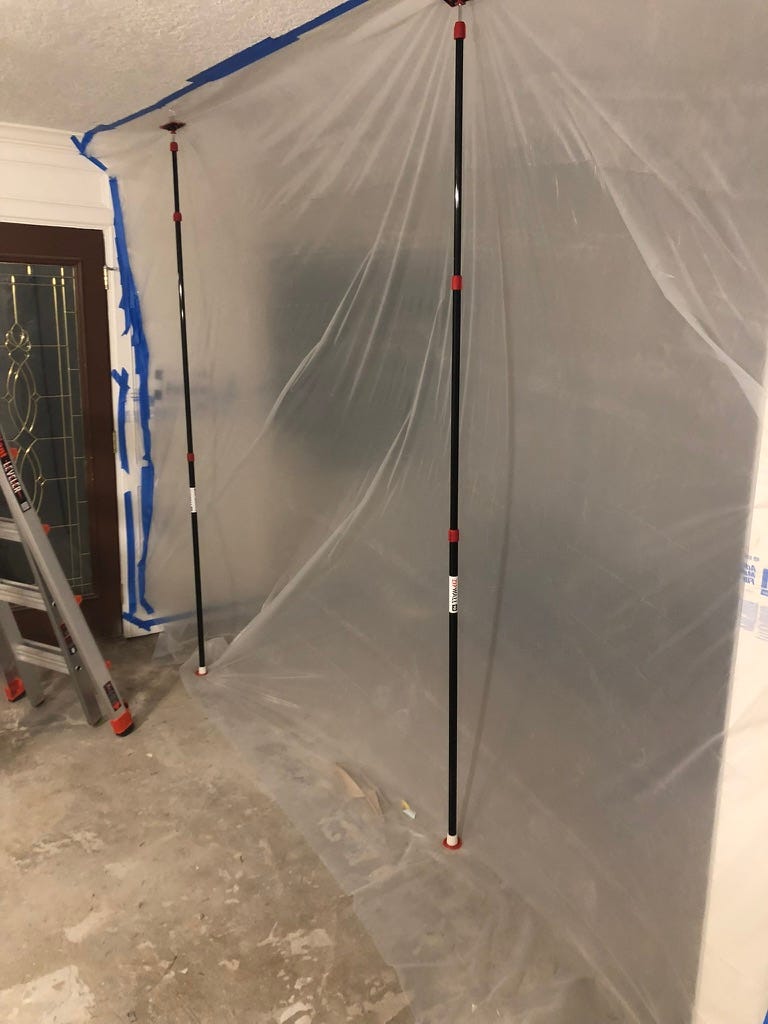
Then I began. I had to strip the floors down to the slab and needed to get started early on a Friday.
Excerpt: Not Made for Tyvek
My uniform that day included a Tyvek suit like the remediation pros, rubber boots, and a dual-cartridge respirator. It was July in Houston and the AC in my house wasn’t on and I was wearing an impermeable suit while working indoors. What could go wrong?
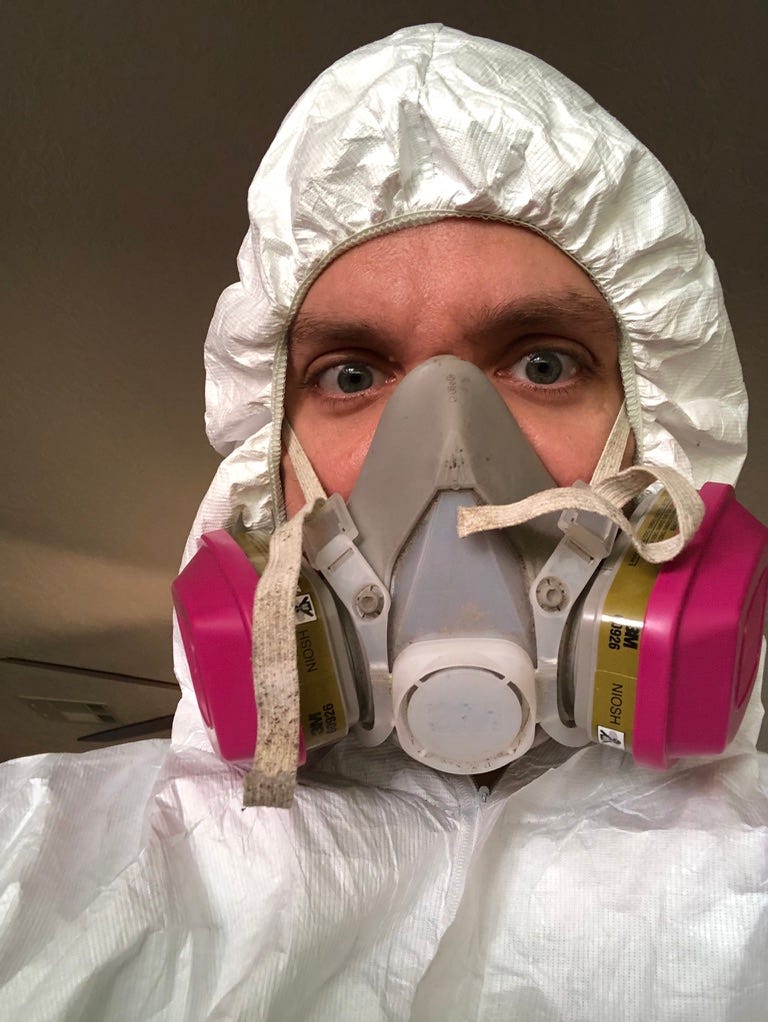
Time to start.
I poured a bucket of water onto the floor, which included self-leveler (from our renovation), old tile mortar (from previous work), and the old asbestos linoleum (original to the house). I had to get through all of them to expose the slab and I was there for as long as it took.
Water. Grind. Shovel.
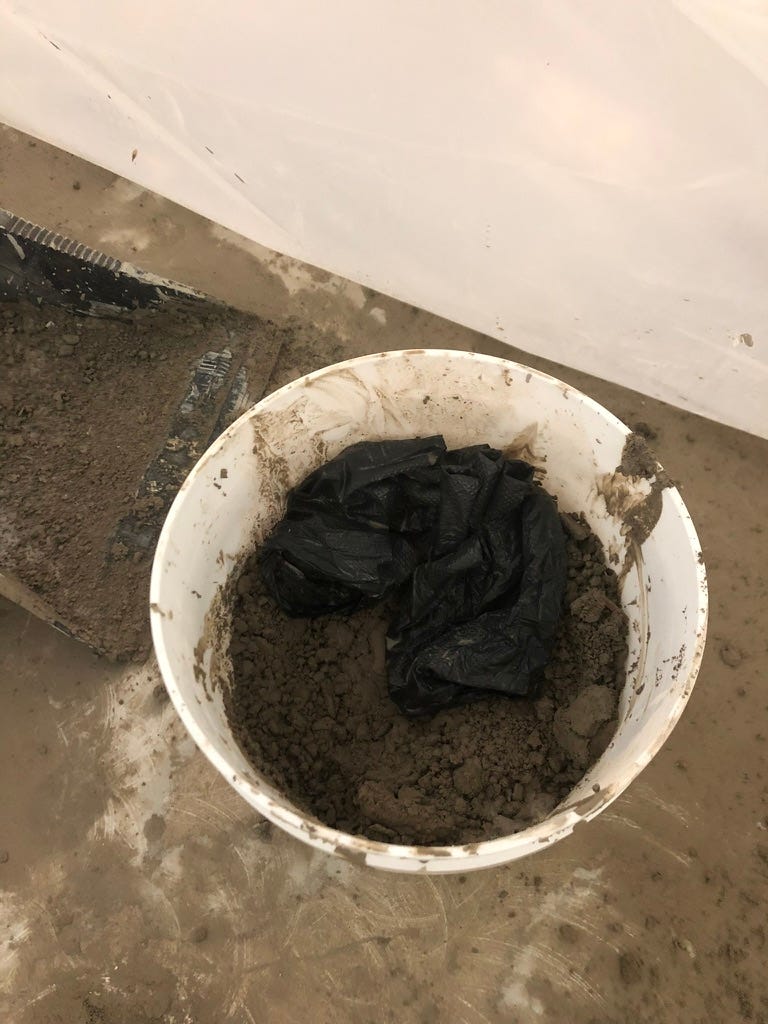
Each pass of the grinder created a gross concrete sludge that I had to shovel out and dump into a bucket. I was sweating so much that my Tyvek suit was filling with it.
Squish. Squish. Squish.
Each step over time getting noisier and grosser in those boots.
Water. Grind. Shovel.
A few hours later I took a minute, let the concrete dry out some, and surveyed the scene.
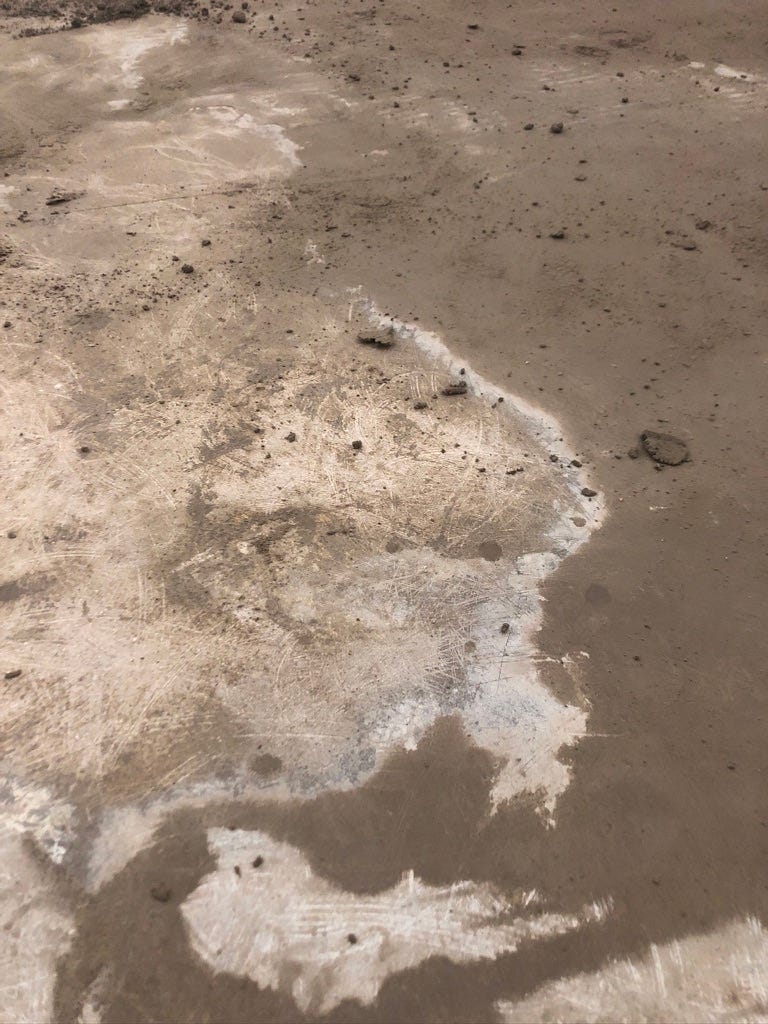
I wasn’t sure I’d made any progress. I mean, I saw circular lines in the concrete from the grinder I’d rented, but I didn’t see much progress in the floor itself. I kept trying.
Then I went into the garage, which contained our entire downstairs, and changed. I assumed my clothes were dead so they went into the garbage. I couldn’t go home (at that time, my sister’s house) in asbestos clothes.
But I didn’t go home. I went to a local park because I’d scheduled concrete day on the same day as the church picnic. So I moved from a house with no AC to a grill outside at a park—a grill I’d made so hot you’d fry if you got near it. I grilled the chicken and burgers and sausage people had brought.
I saw the kids so that they could remember what their dad looked like. I talked to Courtney. Then I went back to the house, put on another Tyvek suit, and got back to work.
By the end of the day—after 10PM by my last photo of dirty boots—I’d made next to no progress. I left the house messier and in worse shape than I’d found it. I changed and got back to my sister’s defeated, dirty, and with fewer options than when I’d begun.
Tunnel Vision on Lesser Things
I spent months of 2018 and 2019 largely navigating my house issues—both the original renovation (2018) and the journey of redoing the entire first floor with epoxy (2019). My email history is littered with requests for help and advice on what to do. I now know more about moisture mitigation than any human should and I’ve made zero dollars off of that knowledge. (However, I can help my neighbors when they get the same issue because I now know how to address it and not just mask it.)
I also continue to deal with mild house trauma and still pray about it so anxiety doesn’t set in.
Am I glad it happened? Debatable. I am glad for the army of people who helped and the relationships forged through concrete grinders. I’m grateful for my brother and cousin spending a Sunday with me to epoxy almost the entire first floor bit by bit.
But tunnel vision is expensive in ways that don’t show up on an invoice.
I mortgaged away months of my life staring at that floor. I spent thousands of dollars on my solution. I stole away time from family and friends. I lost plenty of sleep. My mind could rarely be present in any one place.
We were experiencing a year of significant family transition—changing jobs, moving to a new state, changing schools, settling into new routines—and I was trying to distribute my focus as if I had an inexhaustible supply.
I got hyper-fixated on fixing.
I neglected the people closest to me. I lived a half-distracted life.
I know it’s “just a season” but “just a seasons” stack up. All of a sudden you’re in a vortex you can’t escape and have a pain in your upper back from wearing the stress.
It comes on faster than you might think. . .and then you wonder what you lost.
We all can get caught in a black hole of making less significant things feel more significant. When it happens, how do you get out? And what has it cost you?
I like the pics! I don’t think I’d seen all those yet!