


I’m not sure how many times in my life I’ve heard the word “accountable.” Seems like every week someone is talking (or complaining) about accountability.
Maybe you’re at work and you get exasperated. For the third week in a row, Terry didn’t get his work done. “No one here wants to be accountable. It’s ridiculous.” (Whether or not you got your work done is conveniently redacted.)
Or you are at your church and you meet with someone who is struggling. “Accountability partner” is a common church phrase, so you pair up because you “need the accountability.” Accountable to what? To whom? What are the stakes? TBD. But you do it because it’s a good thing to do.
I ask the question, “So what do you need from me?” a lot when I’m meeting with people.
“I need you to hold me accountable.”
When I get that response, my answer is almost always the same: “I won’t do that.”

Sounds harsh, right? The pastor who won’t hold people accountable? The leadership coach who isn’t going to yell at you when you miss a commitment?
But I decline the request because of what accountability often becomes.
I Can’t Own Your Growth
The biggest reason I don’t outright accept the “Hold me accountable” request is because it moves responsibility where it doesn’t belong—outside of the person needing the accountability.
“Hey, on Thursday can you remind me that I need to talk to John?”
“No. Why don’t you just set a reminder to talk to John on Thursday. You know there are easy ways to remember that, right?”
But we often say “Yes” because it feels nicer. I’d argue it is harmful. We take on for people something that isn’t our responsibility. So now I have to take care of my own life, my family, and your inability to remember talking to John? No, thanks.
If you say “yes,” you might have to get an accountability partner to remind you to remind someone they need to talk to John. The cycle never ends, and the responsibility keeps moving from one person to another.
This type of “accountability” is everywhere. “Let’s make this issue someone else’s problem,” it says. That way, if we don’t do it (and no one follows up with us), we aren’t in trouble.
You Can Still Hide
That’s the other side of the accountability problem: you aren’t sure how honest someone is actually being. Perhaps Dr. House is a little overstated, but there’s a ring of truth to his “everybody lies” mantra. It’s self-protection at its finest.
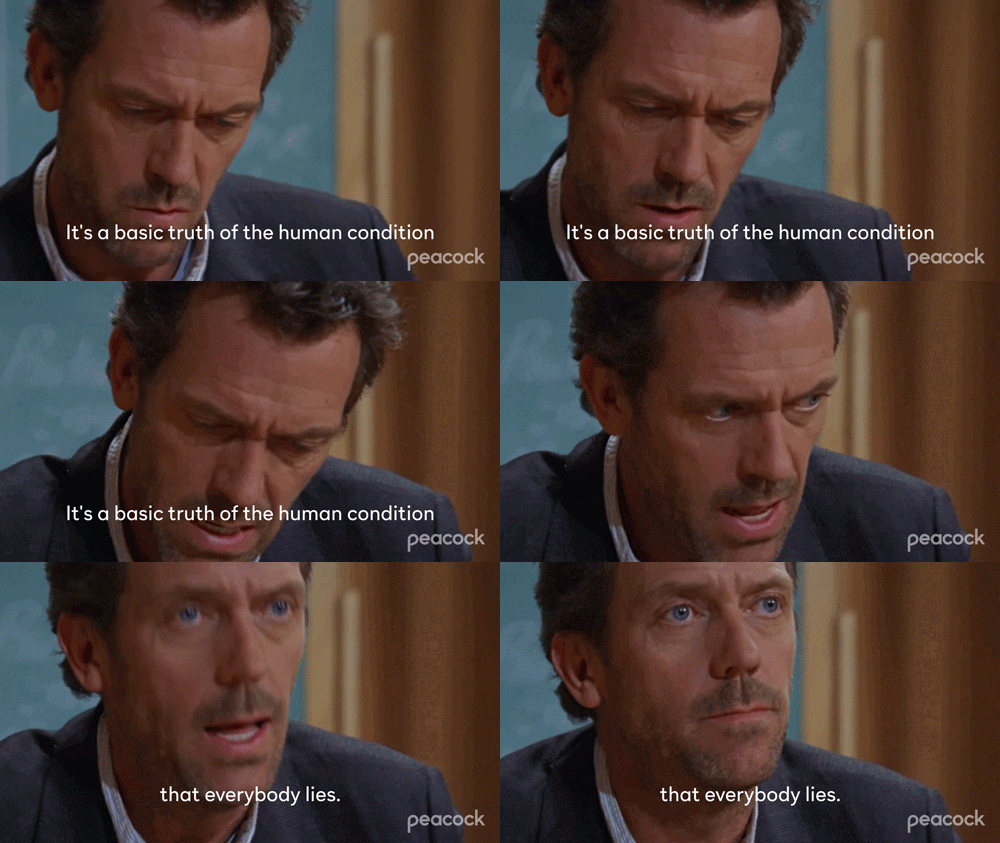
Haven’t you seen it? You hold just a little back about how the week really went. Or the co-worker doesn’t say exactly how the meeting finished up and where the relationship with the new client is. How am I supposed to know the truth? Am I going to guess? Or walk around on an accountability witch hunt? I hope not. Living in suspicion of everyone and everything sounds miserable.
I’ve had people lie straight to me. People I love. People who would gladly promote the need to be accountable, to be honest, and always be vulnerable. Then you realize they’ve been lying to everyone for years.
My longtime mentor, Kevin, has a line that embedded itself deep within my mind.
You’re only as accountable as you want to be.
I live by this. I don’t even know the depths of everything in my mind and heart, but I know them better than you do. So how are you going to hold me accountable? I know when I’m lying to you. I won’t always know when you’re lying to me.
A note for church folk: Don’t decry this idea just yet. One of the clearest areas Christians are supposed to be accountable is in the area of confession of sin. But the command isn’t to ask people to confess sin to you, it’s “confess your sins to one another . . . .” (Jas 5:16). At times, we have to get highly engaged in the process (Gal 6:1), but everyone must own what is going on in their hearts. We cannot do it for them.
The temptation to hide exists in every accountable relationship—at work, at home, at church, or on your baseball team.
And yet I’m still quite hopeful . . . .
Gently Deflect and Redirect
I think there’s a better way to enter into the “Will you hold me accountable” question: a gentle deflection and a redirect to what the person more honestly needs. Allow me to play it out.
“I need you to hold me accountable to leaving work at 5pm every day.”
“How so?”
“Maybe ask me when we meet when I’ve left the office.”
“Why is that what you want me to do? By that time you would’ve already done it or not done it.”
“But I need to leave by 5pm and I need the accountability.”
“Who are you doing this for?”
“My family. I need to be more helpful at home and if I’m not careful I can work all day.”
“Then why do I need to ask you about it? Sounds like you need to tell your wife what you commit to her to do for the sake of your marriage and family. She’s more important to you than I am. Put yourself on the hook in your marriage.”
*Person squirms*
“Yeah, but that’s harder.”
“Isn’t that the point?”
“I guess.”
“When are you going to have this conversation with your wife?”
“Ugh. Probably today.”
“Great. I can’t wait for you to text me tonight and tell me how it went.”
I believe many people want—and appreciate—accountability. What they struggle to find is the right way to live it out. The best approach I’ve found is to hand responsibility back to the person asking. Otherwise you start to take on tasks that weren’t yours in the first place.