


Courtney and I are raising three boys. They’re all teenagers They’re all unique. With our first, we wanted to know the gender before he was born. With the next two we just rolled with it and found out on delivery day. The next two times, “It’s a boy.” Reminds me of a line from the late, great Mitch Hedberg.

When we were younger we’d get the warnings. “Three boys, good luck!” People would want us to know things like, “They will eat so much when they become teenagers,” or, “You better start to keep the girls away now.” It was also common to hear, “When are you going to have a girl?!?!”
But nobody gave me a warning about the amount of butt holes that would be in the house.


The problem started a number of years back with a game or two. One game was called “Fight,” another was called “Extreme Mattress Funinator.” “Fight” goes a lot like you would expect—you fight (more wrestle). Two of the boys took to that game. When they played, it sounded like Jumanji upstairs.

“Extreme Mattress Funinator” had different rules. One boy would get into the corner of the room. Another would take a mattress and stand it upright in the corner—blocking his brother—and then lean with his back against the mattress to keep it upright—slightly bent at the hips for what comes next. The trapped brother would climb to the top of the mattress—using his brother on the free side as support. Then the free brother would run out from under the mattress as fast as he could so that the trapped brother could ride the mattress the 90 degrees from upright to horizontal.
But, over time, we’d get a kid coming downstairs.
“There’s a hole in the wall. I ran into it playing.”
“You what?”
“Well . . . we were playing and my butt went through the wall.”
Then again. And again. And again. Back, hips, butt. Lots of holes.
One bedroom—the funinator corner—currently has at least five holes of varying sizes. A couple were small enough to put tape over. One was so big I needed to cover it with foam board. Others are quite large and I’ve just left alone.
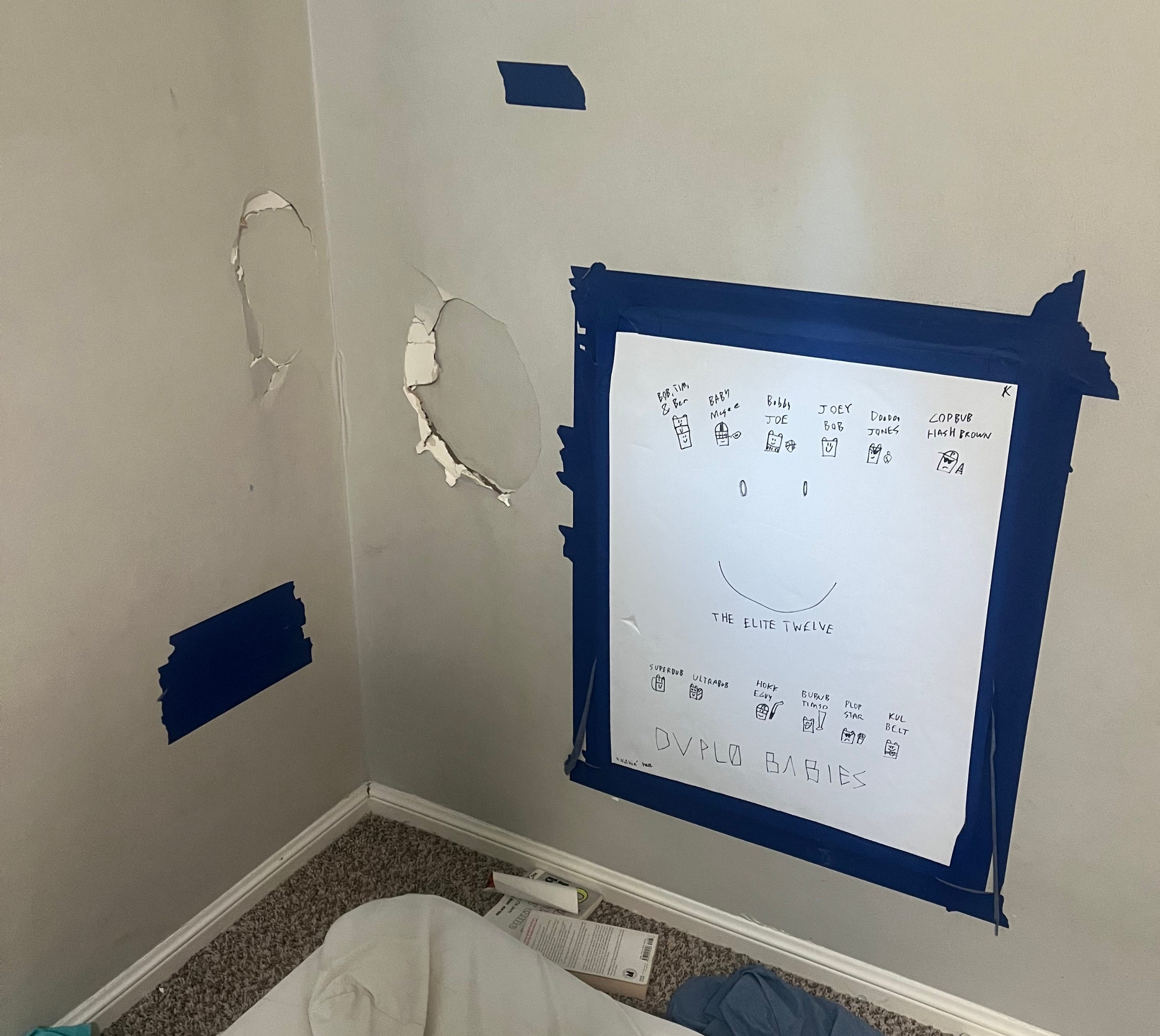
“You could fix these,” you might say. One day, but do it now and there’d just be more damage later. “Fight” isn’t played as much. Now there’s incessant jumping. When you’re a boy, jumping and touching the ceiling is a rite of passage. Your fingertips barely hitting the eight-foot ceiling is the gateway drug. Then you keep trying—one hand, whole palm, two hands, two palms. And as you jump, you hit things on the way down.
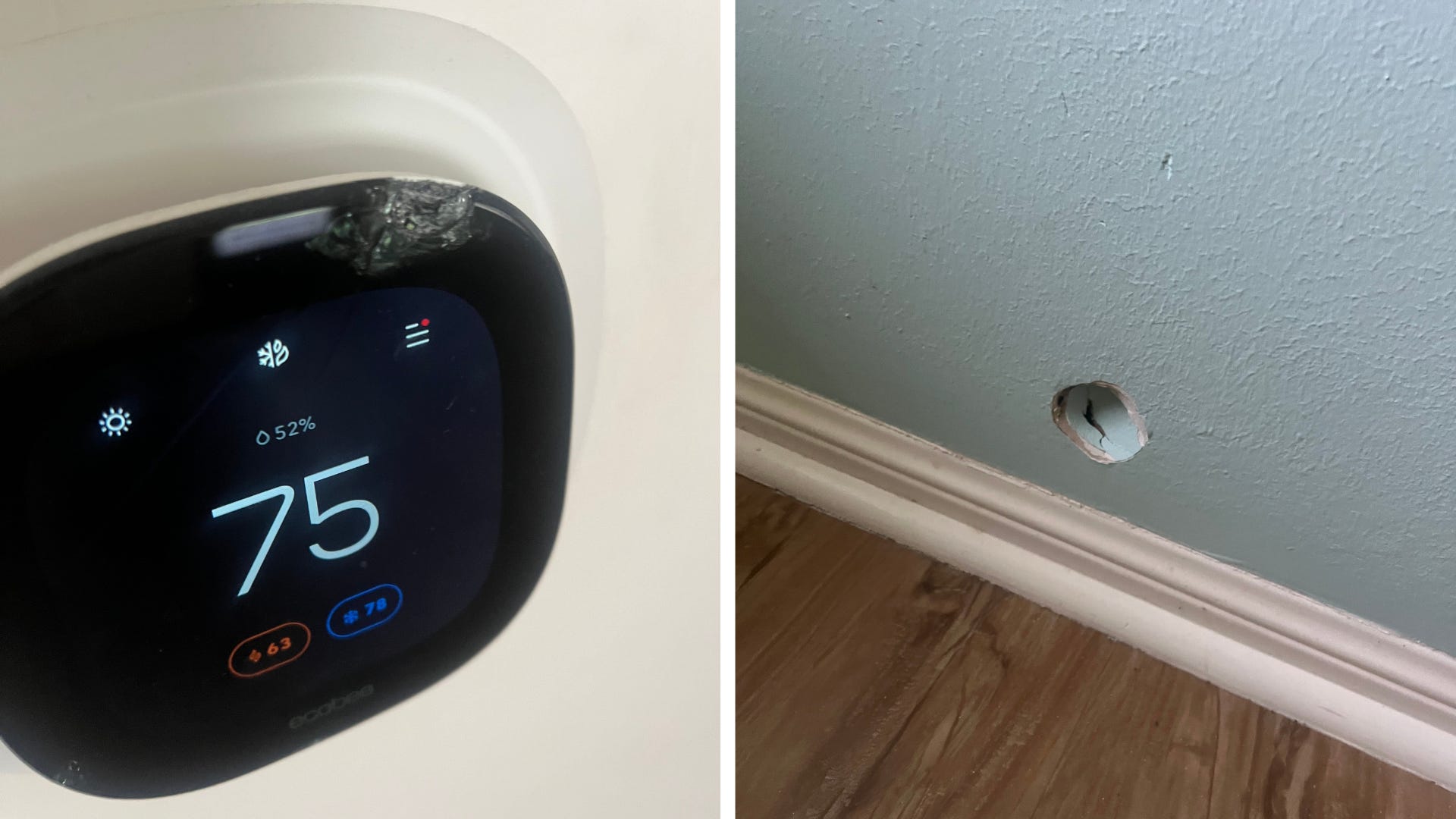
In our case, you hit the thermostat on one jump and your heel hits the bottom of the wall on another. For those last two I got a little suspicious.
“How the heck did you hit the thermostat that was against the wall when that’s not on your jumping path?”
“How did you swing your heel into the wall as you jumped in the bathroom?”
But it happened.
Children age houses at least at 5x the speed. Our house is 48 years old and we’ve lived in it about eight years, so you do the math (80 years?). When football was the front yard sport, at least 20% of our yard was missing grass from all the traffic back and forth. We’ve broken two of our garage window panes—one is still missing. During COVID the kids turned the backyard into a mini golf course complete with water hazards. It was a soggy, muddy, grassless mess. I’m not sure what it cost to re-sod, but it wasn’t a little.
And we’re fine with it.
I heard my grandfather had a phrase about the destruction his grandkids might bring to the house. It was his way of saying to his kids (my mom and uncles), “Don’t worry about what happens to the house.”
If they can break it, it isn’t worth having.
He served in the Marine Corps during WWII on the Pacific Front—being awarded two distinguished flying crosses. He had a display case—unlocked—upstairs with his prized medals and items from his career. At some point in time one of the grandkids (I promise it was not me, but I’m not sure who) lost or misplaced one of those items. I remember Grandpa wondering where it went but not expressing his frustration beyond that. I’m unsure if it got recovered.
In a world that asks, “What’s the return on investment?,” butt holes in houses fit into a unique category. What’s the return? We’re always counting the cost, aren’t we? If we invest in a company, what do we get back? If you pay for youth sports, will your kid get a scholarship (unlikely)? If I buy this house, can it appreciate and how quickly?
But what about butt holes? And what about the relational development that comes from them? They create a house that costs more money to fix. And what about football in the front yard that produces mud puddles when it rains? What will the neighbors think with one house that does not look like the others?
What costs are we willing to incur to create environments that are secure for those growing up in them?
I can’t answer that last question for you, but I can say that very often—be it parenting or leadership of any type—there are hard costs and there are intangible costs. If we only obsess about the financial returns, then we might prohibit some of the relational returns that are actually where the memories are made. We might forget that environments of safety and trust are more valuable than the list price.
Where might you need to redefine the cost?
Thanks for reading. One of the best ways you can support the work is by engaging. Do one: hit the like button, comment, or share with a friend. It’s a simple way to grow the community.
I love Monday morning Hans-stacks! Having 2 boys; I was always puzzled at their definition of play! They did things… I will never understand, however I am grateful they had a space in which they could just be boys! 😊
Love those boys!! 🥰🥰🥰