


At the beginning of the year I did an informal survey with a team I was working with on their roles and responsibilities. I like doing these little tests to create a quick way to carry a conversation.
The result? About half the team didn’t know what was expected of them. Not shockingly, about half the team didn’t know what was expected of their teammates. Less than ideal.
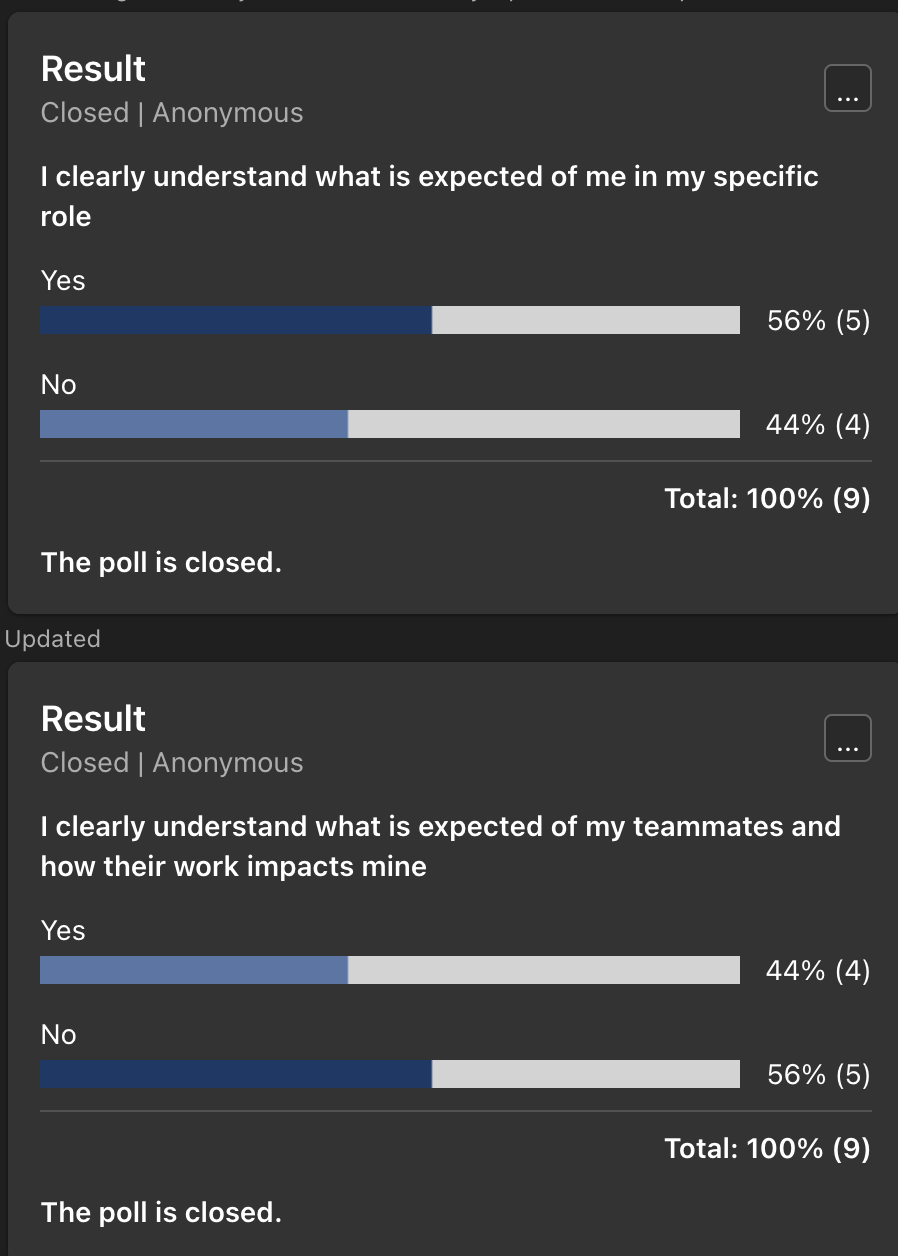
These aren’t fully scientific surveys, but that’s not the point. The idea is to surface just how common it is for people to be unaware—or feel unaware—of what matters most at work. I’d guess you have a situation in your own life that mirrors this idea—uncertainty on what to do, how to do it, what success even looks like.
Many of us spend the bulk of our waking hours at work. However, if we have feelings like people in the team above, we spend much of our day in a fog. Are we doing a good job? How do we know? Who defines it? And why the heck isn’t anyone doing their job?

Ambiguity kills team health, productivity, accountability, and our personal fulfillment.
As I’ve seen teams over the years, ambiguity doesn’t come about maliciously. A team grows too fast and multiplies roles without a plan. Leadership assumes others on the team have institutional knowledge that they do not. Scope creep adds responsibility without any formal communication. It exists in any system from one degree to another.
Don’t forget marriage. The impact of ambiguity isn’t just in the workplace. It happens all the time in family units, too. Husbands and wives enter into marriage with a large set of assumptions as to who should do what. These assumptions aren’t often based on what is right, but on what we experienced growing up. There is nothing inherently more noble about a wife preparing dinner than a husband, or a husband driving on trips more than his wife. Yet the expectations unconsciously determine our feelings of marital propriety.
Often, ambiguity in the team moves a person in one of two directions: expansion or contraction.
“Fine, I’ll Do It”
Some exploit ambiguity to take on more responsibility. This is when the confusion is used to expand a role. I’m bad at knowing motive, and there are many, but these folks are like black holes sucking up any undefined responsibility and taking it on themselves. “If no one will do it, I’ll do it,” is their mantra.
Positively, jobs get done and the person stays busy. Can’t complain about that (though someone will certainly try). Bosses usually appreciate the person who is going to stay busy on the job and accomplish overall goals. These folks are often incredibly eager, too. Win-win.
Negatively, teammates can loathe these people because they can come across as preening. While the behavior might not be performative, we often interpret it as such. Further, the folks who expand their roles in the face of ambiguity are often low-key frustrated all of the time. Nobody seems to ever do their job right and the only way it’ll get done is if they do it.
Just because a belt is loose does not mean you have to grow into it. In fact, that is often the opposite of helpful.
“That’s Not My Job”
The flip side, and often more common among teams, is contraction in the face of ambiguity. Rather than exploit the confusion to take on more, it gets exploited to hide. “Someone else is in charge of that,” is their mantra.

Positively, such a person never rocks the boat. They might not be busy, but they aren’t creating new problems and they likely aren’t frustrating teammates. There’s value there. Leaders need people who aren’t going to consistently cause new problems.
Negatively, this type of teammate plays it safe and comes across as blameshifting. They use the confusion to make the problem someone else. “If HR would do their job, this wouldn’t be an issue.” The problem is outside of them, never them.
Just because you’re uncertain doesn’t mean you can’t act. You don’t need to hide.
“This is the job”
While expansion says, “I’ll do your job,” and contraction says, “This isn’t my job,” the right next step is to confront what is needed for the job. However, everyone has a role to play—and none of it includes waiting around.
If you have a tendency to expand your role, go to the people you’re low-key frustrated with and ask, “I think this is your responsibility. Am I seeing that right?” (It is likely you’re doing 120% of your job and stealing 20% from someone else.)
If you like to hide in the ambiguity, ask the question, “Is this my role? It seems like something I should do.” Take your 20% back and fill the role you have. Don’t make an excuse because it’s easier than making a mistake.
And if you’re observing the issue on a team you lead, bring the clarity that only you can bring. Say, “This is the job and this is who needs to do it.” It might feel easier to let it slide, but nobody grows that way.
You can’t escape ambiguity’s presence on your team—it will creep in one way or another. It’s what we do with it that matters. Regardless of your tendency, you need to confront it.
What’s your disposition and what do you need to do next?