


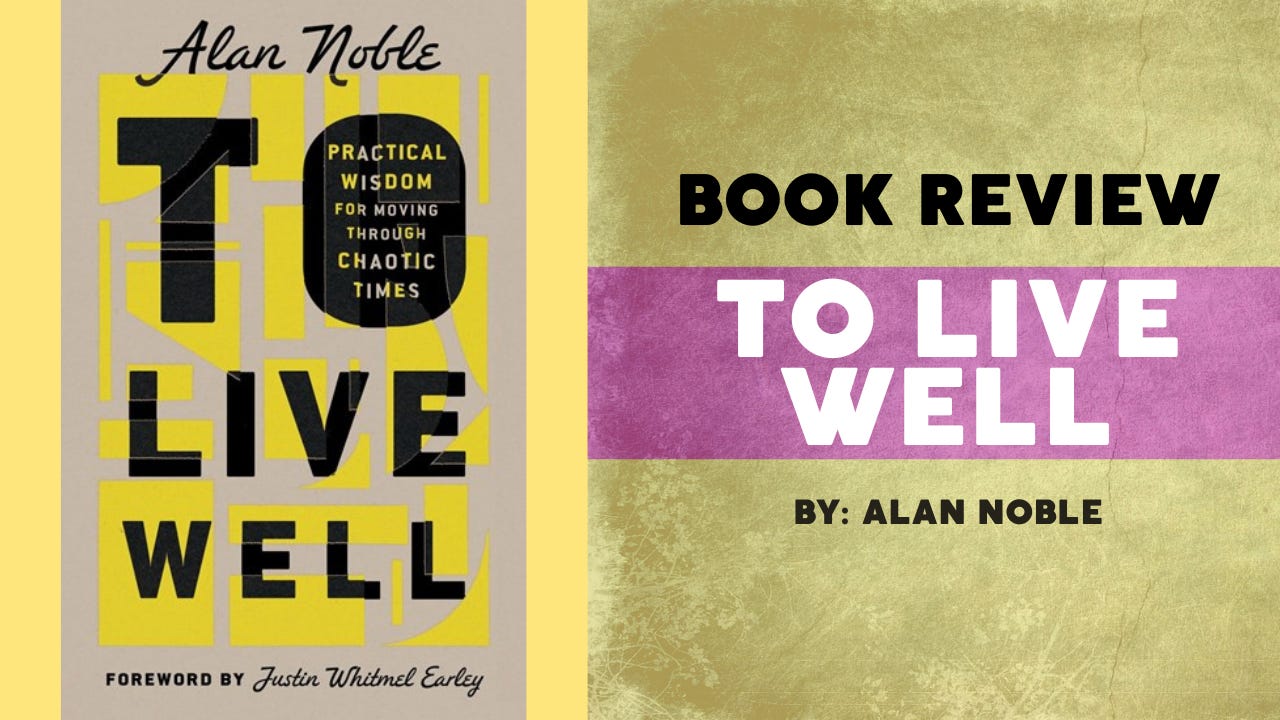
A note to subscribers: This week I bring something different to your inboxes: a book review. While not my normal post, I know all of you are readers (or listeners). If I can serve you by giving you exposure to different ideas, I’m glad to. While a little longer than my normal posts (you can always listen to the voiceover), I hope you enjoy this review of To Live Well.
I’m not one for random Twitter/X challenges, but I just got back on the platform and needed to make some friends. So when author, English professor, and bearded man Alan Noble threw this out:


I felt like it was my responsibility to take on the challenge.

And I know what you’re thinking. “What the heck does the ‘O’ stand for?” Honestly, I didn’t try that hard to figure it out, so I don’t know. It could mean a lot of things—ornery, Oscar, Oliver, Owen. Pick one. What do you think fits a guy like this?
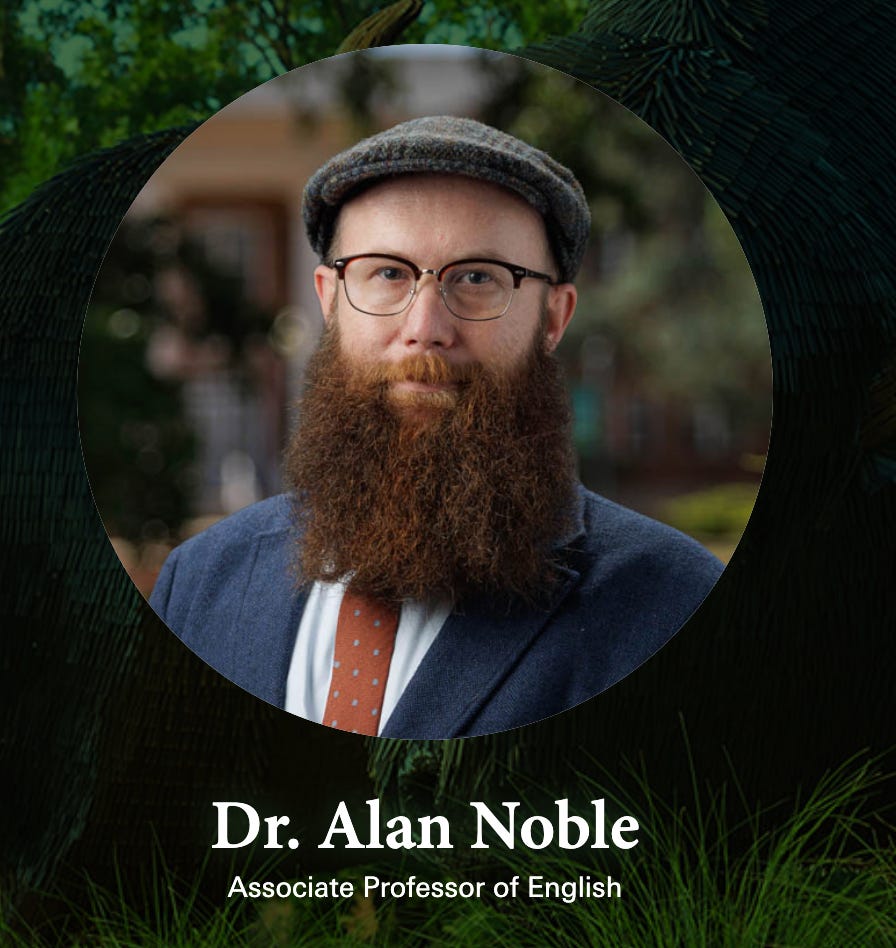
Luckily, you don’t need to know what the first initial stands for (I coached a kid named Oaklen one time), nor do you even need to know this guy is an ENGLISH PROFESSOR to know that he writes books.
He (or his publisher) titled his recent book To Live Well: Practical Wisdom for Moving Through Chaotic Times (IVP, 2026, 200pp). You can find it wherever good books are sold. There might be bad books mixed in but that isn’t Alan’s fault.
Get Ready for Virtue
Noble writes out of a concern—and it is one many share, regardless of faith tradition. “My fear,” he states, “is that modern society has conditioned us to be full of ‘morality’—albeit shifting and ambiguous morality—but lacking any virtues because it denies we have a telos [a defined end]. As a result, we are anxiously striving to do the right thing but never sure what the right thing is” (7). (Also, this fear certainly sounds a lot like a dad who is raising a family while simultaneously teaching young minds in a university setting. He has a front row seat to how things are going in an up-and-coming generation.)
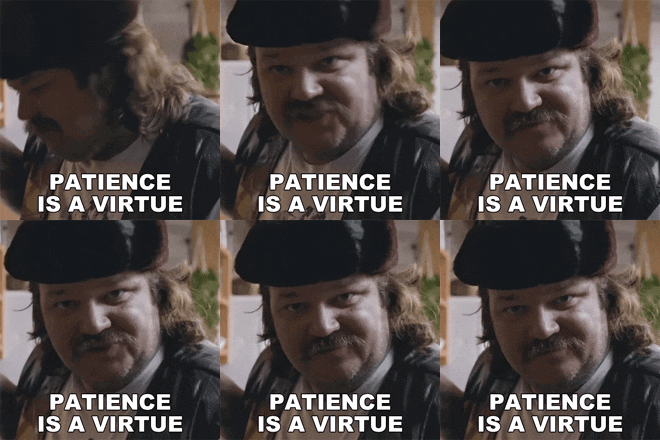
Noble devotes seven chapters to seven virtues: prudence, justice, fortitude, temperance, faith, hope, and love. He uses Thomas Aquinas’ categories of cardinal virtues (the first four big words) along with the theological virtues (the last three easier words). And, no, he doesn’t directly address patience—which is the one virtue probably anyone can name. The reason for this is intentional because, for Noble, those Big 7 cover the rest.
For the Christian in the room, I can sense what you’re thinking, “Great, another book about slowing down, focusing on good things, being a better person, and feeling bad that I’m not enough of those things. Isn’t that what John Mark Comer is for? Or let’s just go to OG Dallas Willard. And can’t I Atomic Habits myself into a better person?”
I think we need to give Noble a fair shake here. While you’ll see overlap, those authors aren’t going after the same thing (or telos).
Unpacking the Virtues
Let’s start with the definition, so we don’t get lost in the shuffle of big words.
“Virtues are cultivated habits that align us with who God created us to be” (7).
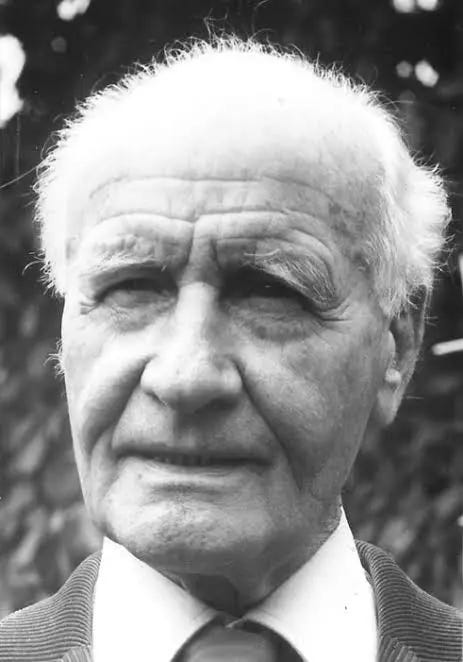
For the backbone of the book, Noble leans on noted Aquinas Scholar Josef Pieper (d. 1997). (This is not noted modern day pastor and scholar John Piper, who I am confident someone, somewhere assumed was who he was talking about.)
This is Josef Pieper:
What Noble wants to do is align a deeper desire for the virtue with specific ways to apply those virtues in the real world. Think of the book as accessible-yet-practical philosophy—a virtue primer. You’ll be introduced to ideas you are familiar with but said in ways you might feel are unfamiliar. Then, Noble brings it back down to earth with simple areas of life in which we can apply them.
The Cardinal Virtues
In looking at prudence (Chapter 1’s “Choosing Decisively”) Noble encourages “(1) seeing the reality of a situation, (2) recognizing and desiring what is good, (3) deliberating, (4) making a judgment, and (5) resolutely acting on that judgment” (18). Prudence is not just deciding, but deciding based upon the good of a situation. As he closes the chapter out, he urges us to remember there is not usually only one right decision (our career, our choice of spouse), but that what must happen is, after all is considered, to choose and remain resolved. (And I speak for many husbands, we are glad our wives are stuck with us.)
Prudence rolls into justice (Chapter 2’s “Acting Justly”), which is every man being given his due (46). He speaks of legal justice (our response to governing authorities), distributive justice (the government’s obligations to us), and commutative justice (what we owe to one another) (48-52). I found myself stuck more on this final version—between us and another. Noble speaks of our debt to our parents, and even to our city, for forming us. We cannot pay such debts, but our posture toward those people can be one of gratitude and charity. In other words, specifically as Christians, we have an obligation to give beyond what is due (grace) in personal and societal situations.
Fortitude comes next (Chapter 3’s “Suffering Steadfastly”) and is defined as “perseverance under suffering for the sake of a greater good” (68). There’s much to be said here, but you can see how the virtues necessarily interplay (thus, you can’t just pick one, you need to go all-in). Why would I suffer for something that isn’t good (needing prudence), and how could I endure if I were not thinking about how justice applies? And we all know what that sounds like, amiright?

Did you know you don’t have to pursue everything you want? Temperance is where we head next (Chapter 4’s “Living Moderately”). Quoting Pieper, we learn that temperance is how we “dispose various parts into one unified and ordered whole” (86). More than just moderation, temperance is a proper ordering of life to leave the capacity to serve others. “You owe it to God, others, and yourself to defend the inner order of your life through the practice of temperance, because it is through that inner order, through self-control, that you are able to have the base to move outward to help other people” (89).
The Theological Virtues
Noble ends with the theological virtues: faith, hope, and love (1 Cor 13:13). Using Hebrews 11 as a guide, Noble defines faith as both an assurance and conviction “about something which is not immediately evident” (Chapter 5’s “Believing Soundly”). Noble says “the virtue of faith allows us to know God and live more fully as human beings created by him” (112). This chapter had one of my favorite quotes.
The modern person can be into Roman Catholicism one year, MMA the next year, competitive fishing the next year, Islam the next, Taylor Swift, Pokémon, video games, ultramarathons, racial injustice, couponing, and so on. (116)

Many around us are doomsdayers. I myself am not, nor is Noble. I have great hope in what will be (Chapter 6’s “Hoping Resolutely”). As Noble states, “Hope believes that God is making all things new through the power of his resurrection” (127). This doesn’t mean things will continually get better, but their end is better. Despair can kill our attitudes about this world (132). “What matters is the decision of our wills, our intellect. What are we choosing to believe and act on?” (133). I appreciated Noble’s longer treatment of apathy (acedia) at the end—because such apathy can kill a home, family, church, or soul.
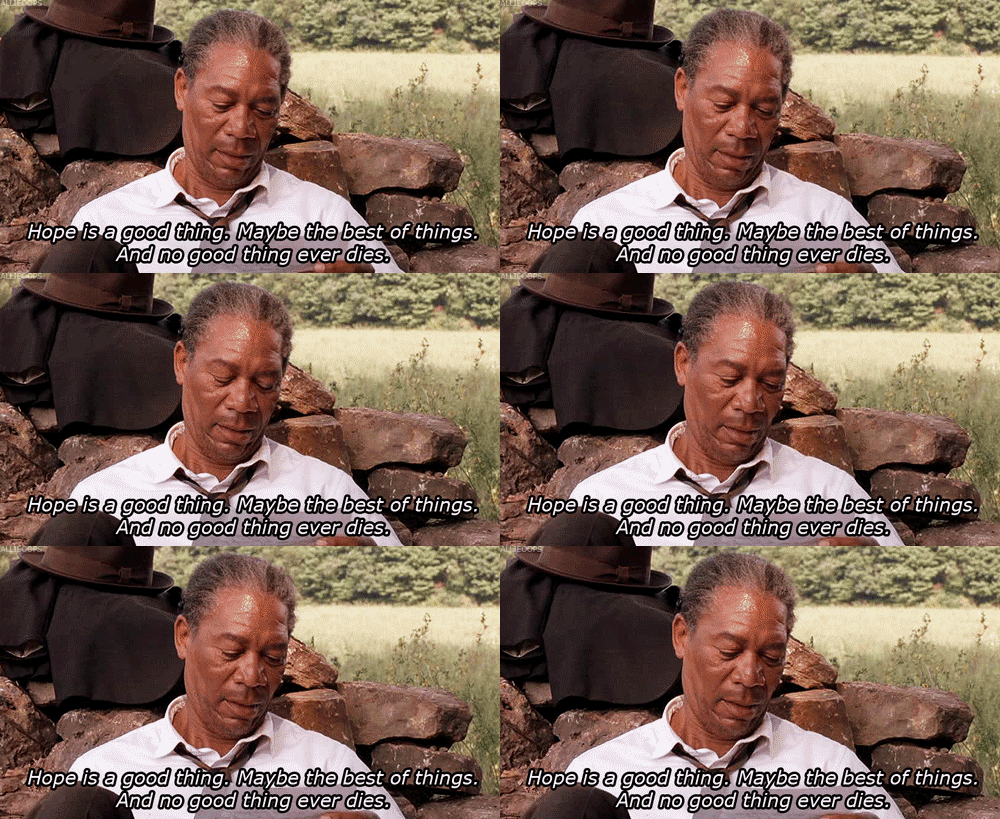
And, as expected, we end on love (Chapter 7’s “Loving Rightly”). “Love is an affirmation of the existence of someone or something that is willing to sacrifice for the goodness of that love” (146). Or, quoting Pieper again, love is saying to someone, “It’s good that you exist; it’s good that you are in the world!” (147). We choose this type of love; we do not first feel it. Its existence sits deeper within us. My favorite sentence in the book comes from this final chapter:
Love requires attention (156).
Final Thoughts: Nitpicking and a Recommendation
Well, reader, if you’ve made it this far, you might wonder what I think about this book. I’ll start with my nitpicks. I have two.
First, I struggled with some of the structure—and this is likely because I am a bit dense. The chapter titles were not the virtues he named, leaving me to always remind myself of what we were talking about. I am not a Pieper scholar and I’ve typed the word “prudence” more this week than ever in my life (I’m 43 years old). Perhaps an editorial decision before publishing, but I didn’t like that the chapter titles required me to translate what virtue we were on. I also didn’t like that there was a chapter called “Living Moderately” when Noble himself said “moderation is an inadequate definition” (86). But, I preach sermons and I often forget what they were titled; I just throw it in there for the spreadsheet, so I get it. And I also found that the definitions were, at times, buried in the sections where he’d set out to define them. Those aren’t catastrophic issues, but it will mean a reader not versed in the writing (i.e., most of us) needs to slow down and look for constant signposts.
My second nitpick is tied to that idea of most readers: I wasn’t sure who the book was for. Anyone? Any Christian? Younger? Older? I tried to answer the pastor question, “Where or how would I use this?” a lot. My hunch was that, as a college professor, he wrote it for those entering into a new world and establishing their lives, but I wasn’t sure of that until I read something he posted recently:
And that’s where I’d recommend it most strongly—to high school or college students or recent grads, but with a guide. I’ve been to seminary two times over. Maybe they failed me (you can take that up with them), but I had not read Pieper and had to catch myself up with the way he was talking about Aquinas. That’s not Noble’s fault, but shows what men like him are up against.
Here’s what I’d suggest: seven chapters, seven weeks, seven discussions, with enough age in the room to make the discussion good. The result could be transformative. The chapters are accessible, the writing flows, and the topics need to be worked out with others.
Because the virtues, ultimately, aren’t for me just virtuemaxxing. They’re for me to serve you. And to live them out, I need to be by your side and have you by mine.
Hear O Alan (still don’t know what the O stands for) talk about his book on the Outside Ourselves podcast:
Thanks for reading. One of the best ways you can support the work is by engaging. Do one: hit the like button, comment, or share with a friend. It’s a simple way to grow the community.
Even though I’m running late to the game, I think I’ll read it! You n
Sounds like a worthy read. We all need to be constantly reminded of great truths no matter how old we are, and this seems to cover some very foundational truths. Thanks for the review Hans.